
Share the page
EU-AFD Facility on Inequalities 2026-2028: Reducing Inequalities through Investments

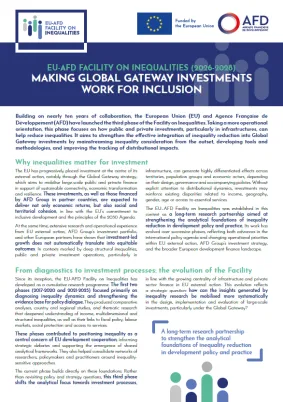
Building on nearly ten years of collaboration, the third phase of the EU-AFD Facility on Inequalities takes a more operational approach: it focuses on how investments – particularly in infrastructures and the private sector – can help reduce inequalities. It aims, more specifically, to strengthen the effective integration of inequality reduction into Global Gateway investments, in line with the EU Inequality-Marker (I-Marker).
Context
While investment has become a central instrument of development strategies, its effects on inequalities remain difficult to measure and monitor. Infrastructure and private sector projects often generate indirect and uneven distributional effects, making it challenging to assess who benefits, how value is created, and how gains are shared across territories and social groups.
Yet investment is a critical lever for reducing inequalities, through access to services, economic opportunities and the distribution of economic rents. This challenge lies at the heart of the European Union’s Global Gateway strategy, which aims to mobilise public and private investment in sustainable and inclusive infrastructure as one of the pillars of EU external action.
Building on the analytical tools and evidence developed during its previous phases, the third phase of the EU–AFD Facility on Inequalities focuses on investment processes, with the objective of strengthening the capacity of European institutions and public development banks to integrate inequality reduction into Global Gateway investments.
Objectives
Coordinated by AFD with €1.68 million from the European Commission for 2026-2028, the third phase of the Facility has three priorities:
- Considering inequalities from the start: the Facility will inform the scoping and early design of public and private investments by providing analyses that highlight their potential effects on inequalities;
- Practical guidance for Team Europe actors: the Facility will develop tools and methodologies to help Team Europe actors better integrate redistributive considerations into project identification and early structuring;
- Better tracking of distributional impacts: using inequality-specific indicators, the Facility will help strengthen the monitoring and analysis of the impacts of Global Gateway investments on different population groups.
This applied research work and practical tools will help the EU and its Member States make informed, evidence-based investment decisions that integrate inequality-reduction objectives into their external action, in line with the Global Gateway strategy. By improving both upstream project design and downstream impact assessment, the Facility seeks to ensure that Global Gateway investments deliver tangible benefits for disadvantaged groups, including the bottom 40%, and contribute to more equitable development outcomes.
Download the presentation leaflet
Components
The Facility is designed to generate applied research and operational tools to support Team Europe actors across the entire project cycle – from early scoping and identification to monitoring and evaluation:
Component 1 – Inform the scoping and early design of public and private investments
Through applied research on private and public investments in strategic sectors, this first component addresses a key upstream gap: the limited and uneven integration of inequality analysis at the earliest stages of project development, especially in investment programming.
By identifying structural barriers, targeting challenges and redistributive mechanisms, this component is intended to help project teams and institutions assess where and how investments can reduce inequalities from the outset, and avoid reinforcing existing patterns of exclusion.
- Research partner: CEDLA
- Budget : 70 000 €
- Timeline : May 2026 – April 2027
This applied research project analyses redistributive mechanisms, governance arrangements and territorial impacts associated with the development of Bolivia’s lithium sector. Conducted by the Bolivian research centre CEDLA, the study combines political economy analysis, territorial diagnostics and comparative international research to identify policy options and investment approaches that can support more equitable, socially inclusive and environmentally sustainable lithium development.
The project will generate new evidence on how lithium-related investments may shape territorial inequalities, local participation, employment, and benefit-sharing mechanisms. It is closely linked to a joint AFD–EU–EIB blending operation, as well as to the EU’s strategic dialogue on lithium and critical minerals in Bolivia.
The research will also explore how future investments can better integrate socio-environmental safeguards, local governance and responsible value creation in the framework of the Global Gateway initiatives and the broader energy transition agenda. Its findings are intended to support both public policy discussions and the design of inclusive investment strategies in the sector.
- Research partner: The Predistribution Initiative (PDI)
- Budget: 60 000 €
- Timeline: May 2026 – April 2027
This research project examines how private-sector investments can better integrate inequality considerations from the earliest stages of project design and appraisal. Conducted in partnership with Proparco and led by the Predistribution Initiative (PDI), the study combines conceptual research with an in-depth case study of a Proparco-supported digital connectivity investment in Mexico to better understand how investment design shapes distributional outcomes.
Building on this case study, the research will analyse how contractual arrangements, pricing structures, employment practices, access conditions and risk-allocation mechanisms may influence inequalities in private investment projects, with reflections extending where relevant to other Global Gateway sectors. It aims to develop an operational analytical framework enabling development finance institutions and investors to identify inequality-related risks and opportunities more systematically.
Drawing on both academic literature and empirical analysis of investment operations, the project will produce practical tools and policy recommendations to support more inclusive investment appraisal and strengthen the contribution of private investment to reducing inequalities.
Component 2 – Operational tools and applied methodologies for inclusive infrastructure projects identification
The second component focuses on anticipating the distributional effects of infrastructure projects – including those with indirect or dispersed beneficiaries – in priority sectors such as energy, transport, digital, health and education.
By providing ex ante inequality assessment methods, sector-specific checklists, and actionable design levers, this component will equip Team Europe actors with concrete instruments to integrate redistributive considerations into project identification and early structuring.
- Research partner: ODI Global
- Budget: 130 000 €
- Timeline: June 2026 – April 2027
This research project examines how infrastructure investments can better integrate inequality considerations from the earliest stages of project design and appraisal. Led by ODI Global, the study combines methodological research with an in-depth case study of the Transgabonais railway modernisation project in Gabon to better understand how infrastructure investment choices shape distributional outcomes.
Building on this case study, the research will analyse how project design, financing modalities, access conditions, tariff structures and investment alternatives may influence economic inequalities across population groups, territories and economic actors. It will explore the relationship between economic growth and the distribution of its benefits across population groups and territories, with reflections extending beyond the case study to other geographies and infrastructure sectors.
Drawing on academic literature, infrastructure impact evidence and development finance practice, the project will develop an operational framework enabling development finance institutions to more systematically embed inequality considerations into infrastructure investment operations. The project will produce practical tools and policy recommendations to support more inclusive infrastructure appraisal and strengthen the contribution of infrastructure investment to equitable and sustainable development.
Component 3 – Monitoring and analysing distributional impacts of Global Gateway investments
The third component strengthens the monitoring and analysis of the distributional impacts of Global Gateway investments:
- Building on the Distributional Impact Assessment (DIA/DIA+) methodology, it will assess how project benefits of investments in priority sectors are actually distributed across income groups, territories and social categories.
- In parallel, it will develop practical inequality-related indicators, adapted by Global Gateway sector and financing instrument (e.g. guarantees, blending), to support consistent tracking and reporting across Team Europe actors, including European Development Finance Institutions (EDFIs) and European Public Development Banks.
Reducing inequalities requires understanding not only whether development interventions generate positive outcomes, but also who benefits from them. To support this objective, the Facility on Inequalities contributes to the implementation and refinement of the Distributional Impact Assessment (DIA) and Distributional Impact Assessment Plus (DIA+) methodologies.
Developed in the context of the European Union’s Inequality Marker, DIA and DIA+ are analytical tools designed to assess, ex-ante or ex-post, the contribution of development cooperation projects to reducing inequalities. They help identify whether the direct beneficiaries of a project belong to disadvantaged population groups and whether project benefits are likely to reach those who are most at risk of being left behind.
The original DIA methodology focuses on the socio-economic profile of beneficiaries using asset-based measures of wealth, while the more recent DIA+ approach expands the analysis by assessing beneficiaries’ position in the income or consumption distribution. Together, these tools provide an evidence-based assessment of the distributional profile of development interventions and strengthen the ability of development finance institutions to integrate inequality considerations into project design, implementation and evaluation.
As part of the third phase of the Facility, DIA and DIA+ analyses will be conducted on a selection of EU–AFD co-financed projects across different sectors and regions. These case studies will test and further refine the methodologies while generating practical lessons on how development cooperation can more effectively contribute to reducing inequalities.
Contact
-
Anda DAVID
Economist, scientific coordinator of the EU-AFD Facility on Inequalities